
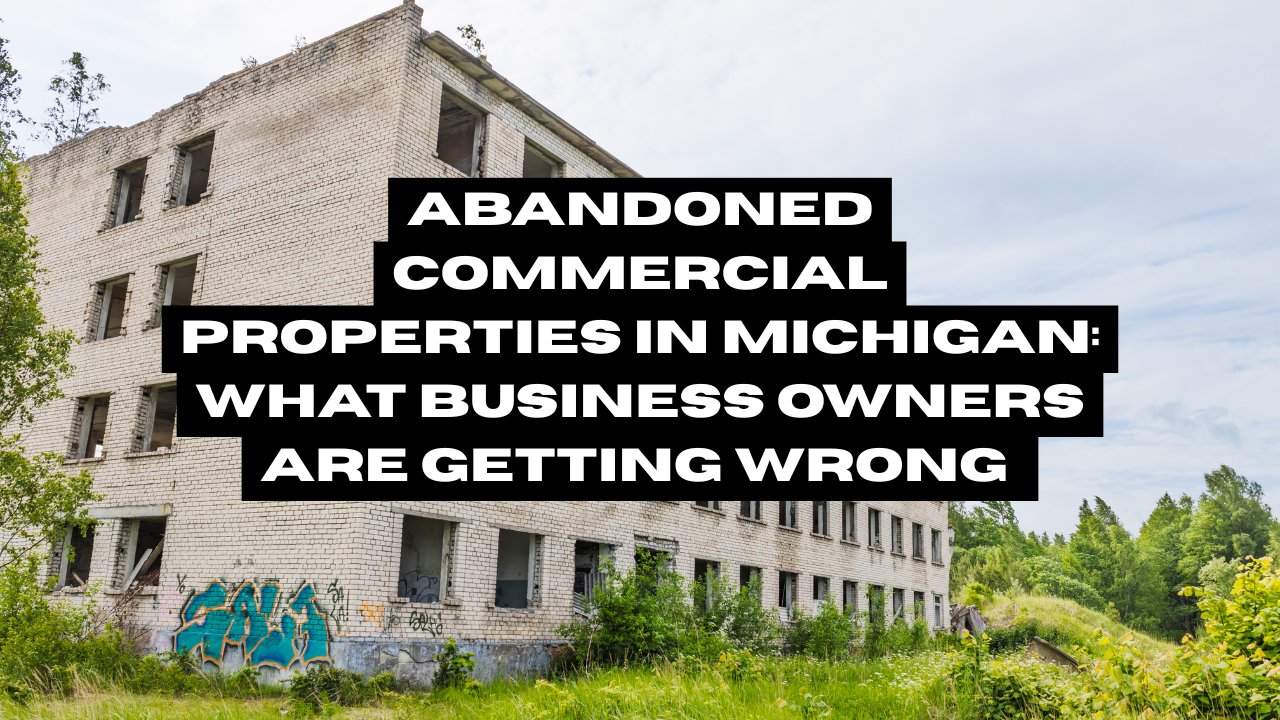
Abandoned Commercial Properties in Michigan: What Business Owners Are Getting Wrong
Abandoned commercial properties don’t usually start that way. Most of them begin with a plan that stalled, a deal that fell through, or a situation that got more complicated than expected.
It’s common for owners to assume that if a building is sitting vacant, they can simply hold it until the right opportunity comes along. Under Michigan law, that assumption can get expensive quickly.
Vacant does not mean inactive. And it certainly does not mean risk-free. In fact, in a lot of cases, that’s when the risk actually starts to build.
Vacancy Does Not Eliminate Responsibility
In Michigan, ownership responsibilities don’t stop just because a building is empty.
Local municipalities, including cities like Livonia, enforce property maintenance and nuisance ordinances that apply equally to occupied and vacant properties. These laws are designed to prevent buildings from falling into disrepair, protect public safety, and preserve surrounding property values. And in many cases, these issues don’t come up until the city — or a neighbor — forces the conversation.
In practical terms, that means owners of abandoned (or underutilized) commercial properties may still be responsible for:
- Maintaining the structural integrity of the building
- Securing the premises against unauthorized access
- Preventing conditions that could be deemed “hazardous” or “blighted”
- Complying with local inspection and code enforcement requirements
When those obligations aren’t met, it usually doesn’t take long before citations, fines, or enforcement actions start showing up. And by the time that happens, the situation is usually already harder — and more expensive — to fix. Weather alone speeds up deterioration faster than most owners expect — especially when small maintenance issues are ignored.
When a Property Becomes a Public Issue
Most owners don’t expect their property to become the “eye sore” of the neighborhood. It can start small — overgrown lots, broken windows, and lights that never come back on. Then nature takes over. Weeds push through pavement, water finds its way inside, and what was once a manageable issue becomes an unsightly nuisance. These things add up — and rarely stay isolated problems. Over time, they start attracting attention — and not the kind owners want.
Vacant commercial properties can also become gathering points for unauthorized occupants, including individuals experiencing homelessness. While this raises serious humanitarian concerns, it also creates complicated legal issues for property owners.
These situations may involve:
- Premises liability risks if someone is injured on-site
- Code enforcement actions for unsafe or unsanitary conditions
- Increased police or municipal involvement
- Potential classification as a public nuisance under Michigan law
Once a property reaches this stage, it’s no longer just a private asset — it becomes a matter of public concern. Once that starts, it’s no longer about ownership, it’s about control — and in a lot of cases, owners realize too late that they’ve lost some of theirs.
Michigan’s Approach to Blight and Nuisance
Michigan law gives cities and municipalities authority to step in when a property becomes a problem — and clearly defines what qualifies as a blighted or dangerous structure. Under local and state-level ordinances, cities can:
- Issue violations and escalating fines
- Require corrective action within specific timeframes
- Perform necessary repairs and bill the property owner
- In extreme circumstances, pursue demolition or court ordered action against the owner
For commercial property owners, doing nothing often makes the situation worse — not better.
The Legal Risk Most Owners Overlook
A common mistake property owners make is assuming that “stepping back” reduces their exposure. Even without tenants or active operations, owners may still face:
- Ongoing contractual obligations tied to financing or partnerships
- Insurance complications or coverage gaps
- Liability tied to foreseeable risks (like an unsecured entry or structural hazards)
- Legal disputes if the property impacts neighboring businesses or properties
The longer a property sits without a clear plan, the more complicated — and expensive — the situation becomes.
Homelessness, Liability, and Your Reality
There’s also a reality that can’t be ignored: vacant buildings often become shelter for people who have nowhere else to go. And once that happens, the situation becomes more complicated for everyone involved — especially from a legal standpoint.
Property owners are left balancing:
- The risk of injury claims
- The need to secure and restrict access
- Potential reputational concerns
- Interaction with local enforcement and community pressure
Ignoring the issue won’t fix it. Vacant buildings don’t stay empty for long — people find them.
What Business Owners Should Be Doing Instead
The takeaway isn’t just “don’t let a property sit.” It’s to understand that commercial property requires active legal management — even when it’s producing no income.
Business owners should be:
- Proactively addressing vacancies with a clear legal and operational plan
- Ensuring properties remain compliant with local ordinances
- Securing buildings to reduce liability exposure
- Addressing disputes, financial issues, or redevelopment delays early
- Consulting legal counsel like Fausone & Grysko before problems escalate
Once a property reaches the point of being a visible problem, you’re no longer making proactive decisions — you’re reacting to problems.
This Is Not Just a Real Estate Issue
From the outside, this can look like a real estate problem. In reality, it’s a legal one.
It involves liability, compliance, municipal authority, and risk management — areas that you can’t press “pause” on just because a building is empty. At Fausone & Grysko, we help business owners address these risks before they become enforcement actions, and to navigate them when they already have.
In Michigan, leaving a property alone doesn’t mean it gets left alone. Eventually, something gives — whether it’s the city stepping in, the community pushing back, or the building itself breaking down over time. And by then, your options might be more limited than you expected.
For additional information on this topic — or more insights on real-world legal issues affecting business owners — watch this episode of Unlocking the Law with Brandon Grysko.