
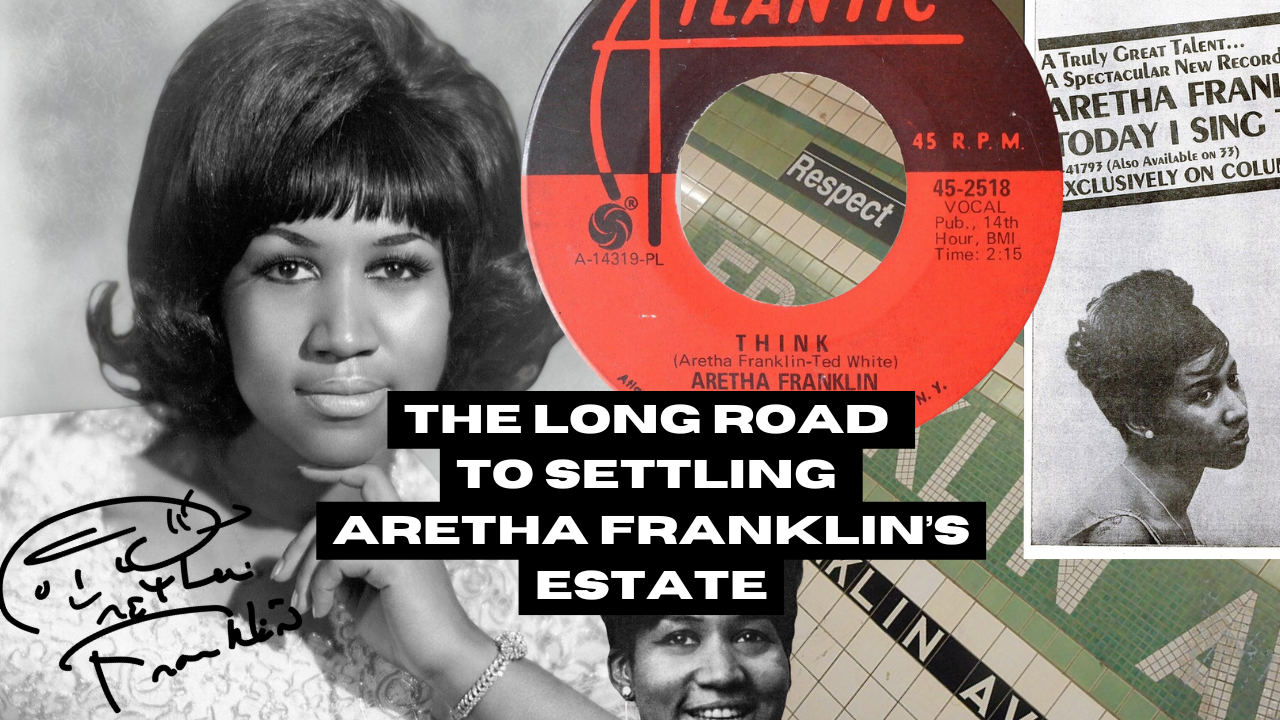
The Long Road to Settling Aretha Franklin’s Estate
Eight years after the death of Aretha Franklin, the legal fight over her estate is still playing out in Oakland County Probate Court.
The case has gone through multiple handwritten documents, a jury trial, several personal representatives, and years of disagreements over Franklin’s property and music rights. In July 2023, a jury decided that a handwritten will Franklin wrote in 2014 was valid.
But that verdict didn’t close the estate. Three years later, the case is still active. By August 2026, more than 1,400 motions, petitions, briefs, rulings, and other filings had piled up on the probate docket.
A Will Found Under the Couch Cushions
When Aretha Franklin died on August 16, 2018, her family initially believed that she’d left no will at all.
That changed in 2019, when handwritten documents were discovered in Franklin’s home. Two documents dating back to 2010 were found in a locked cabinet. Another, dated 2014, was discovered in a spiral notebook underneath the cushions of her couch.
The 2014 document didn’t look like the kind of will most people would picture. It included crossed-out words, revisions, and passages that were difficult to read. But Michigan law recognizes handwritten, or holographic wills, when certain legal requirements are met. What mattered was whether Franklin intended that document to be her will.
The 2010 and 2014 documents contained some important differences. Under the 2014 document, Franklin’s Bloomfield Hills home would go to her son Kecalf and her grandchildren. It also removed a requirement from the earlier document that Kecalf and another son, Edward, complete business coursework and earn a certificate or degree before receiving benefits from the estate.
The disagreement over the handwritten documents ultimately landed Franklin’s family in a jury trial in Oakland County Probate Court. In July 2023, the jury found that the 2014 document was Franklin’s valid will. The jury decided which will would control the estate, but there was still plenty left to sort out.
Why Is the Estate Still Open?
Since then, the disputes have gotten much more specific.
They’ve included financial arrangements for Aretha Franklin’s oldest son, Clarence, who has special needs and is under guardianship. There have also been disputes involving copyright shares in songs like “Think” and “Dr. Feelgood,” along with hundreds of personal items stored in 11 storage units around Metro Detroit.
In 2026, Franklin’s collection of audio and video recordings also became another issue in the case.
Dozens of reel-to-reel audio tapes and video recordings remain in the estate. Some are labeled, while others are not. According to the Detroit Free Press, the video archive includes unreleased material from Franklin’s 1998 “VH1 Divas” rehearsal, her 2003 Freedom Hill Amphitheatre concert, and other Detroit performances.
When it comes to the other unmarked reels, no one publicly knows what’s on them. Beyond their potential financial value, they could also contain historically significant unreleased material from Franklin’s career.
A petition filed this year raised concerns about how the tapes are being stored, and asked that they be moved to a facility that’s better equipped to preserve them. The petition also proposed having an audio restoration specialist assess the recordings.
The Case Has Changed Hands
Aretha Franklin’s niece, Sabrina Owens, was the estate’s first personal representative. While Owens oversaw the estate, several major Franklin projects moved forward, including the film Respect, the television series Genius and the documentary Amazing Grace. But after the handwritten wills were discovered and disagreements within the family intensified, Owens resigned in 2020.
Franklin’s longtime attorney, David Bennett, later stepped away from the case as well. Reginald Turner then served as personal representative. As of the most recent reporting, attorney Andrew Mayoras serves as the court-appointed special personal representative, and Franklin’s sons have their own attorneys. More than a dozen lawyers, including Fausone & Grysko’s Kurt Olson, were still active in the case as of August 2026.
Kurt’s Perspective
This case has presented a challenge to all the parties and attorneys involved. I think it is fair to say that it involves more legal issues than most probate cases: everything from trying to admit documents intended to be a will under MCL 700.2503, to whether the 2014 document replaced the 2010 document when there was no revocation clause and some contradictory provisions, as well as many administration issues. The distribution of the intellectual property and the interplay between federal copyright law and Michigan probate law are perhaps the two major issues still remaining, although these are by no means the only issues remaining.
Getting It in Writing
Aretha Franklin’s estate is unusual in almost every way. Most families aren’t sorting through music rights, unreleased recordings, and property belonging to one of the most famous singers in American history.
But the question at the center of the case is one every family can understand: What did she actually want? Her family ultimately had to turn to the court for an answer.
A clear estate plan can’t prevent every disagreement, but it can leave fewer decisions (and less mess) for family members, attorneys, and courts to sort out later.
At Fausone & Grysko, Kurt Olson and our estate planning attorneys help individuals and families put those decisions in writing. That can mean preparing a will or trust, establishing powers of attorney, or updating an existing plan after a major life change.
If your estate plan is outdated, incomplete, or something you’ve been putting off altogether, Kurt and the Fausone & Grysko estate planning team can help. And if questions or disputes arise during the administration of an estate or trust, our experienced probate litigation attorneys can step in to help navigate those challenges and work toward a resolution. Contact our office today to schedule a free consultation and start putting a plan in place.